- Welcome to Discover Desire Good.


 Search

There is a seldom talked about passage in the Bible that focuses precisely on the gender roles of a man and a woman.
This one chapter dictates much of the gender roles throughout scripture, yet it is nearly forgotten from the pulpit other than being in the Bible itself.
Specifically, this passage focuses on a married man, his son (either married or not), a married woman (his wife or his daughter), and a single woman (his daughter, his daughter as a widow, his daughter as a divorcee, potentially his wife - if he is deceased).
----
That passage is the chapter of Numbers 30. It has changed my life, literally.
My take away from it is this.
It comes down to fault. The chapter shows that whatever the decision that is made, if it goes south, then the results of that decision are always the man's fault because he had the authority to annul the decision that caused the results.
From the opening of the chapter, the law is straightforward. The man, not the woman, is always obligated to do what comes out of his mouth. He is accountable for what decisions he allows in his house. No one is at fault other than him. His wife and his daughter are free from fault even if he agrees with a decision that either or both make. Him; not the women - is solely at fault for the outcome. His sons are under the same yoke as he is, except they are not accountable nor at fault for the women in the house unless a woman is his wife.
So I teach my sons and my daughter ... be accountable ... because it goes very well in life. Happy husband = accountable wife and children.
Track through our country's history, and you will find a persistent truth.
Men are most often blamed (at fault) for what goes on in their homes. Thus, they are most often considered the "head" of the house, aka the "authority" of the house. In socially correct terms amongst the humble, he is the lead of the house.
In the way past, legally, women and children had no rights to make decisions outside of the home - over top of the husband/father, yet can you see why that probably was the status quo within a marriage? Socially, can you see how that might have played out?
I can. I remember.
But I also remember wives being abused and children as well. Come to our modern day, and I remember husbands and children being abused.
The focus of Numbers 30 was this. The Law (of God) is the head of the husband.
Today, we have "the law of the land" is the head of everyone.
So without God's focus on a household being under his rule, I can see why man's laws went weird and abuses happened and happen now. It is because there were still yet other laws that provided checks and balances for abuses within the home in the Law (Bible).
It is like this.
First, comes accountability. Second, comes fault. Third, comes authority.
A man, a wise man, processes accountability first. Then he considers fault. Then he considers authority last.
Whomever is to be at fault ultimately is the person ultimately who has the authority.
It's not a question of authority. It is a question of fault.
We have sayings in our country such as, "If you can't do the time, then don't do the crime."
-----
Can you see authority, accountability, and fault playing out in that statement?
-----
When you read the Bible and see men mentioned more than women, consider that the are mentioned because of their position for taking fault, being exalted or demeaned for the decisions they made, and what they did to earn that status. Then think the same of women and how many are shielded from being made into public spectacles.
It's not that the Bible is sexist. It is that men bear the burden of being at fault and bear the punishment else the praise for the decisions they make. Men are in the forefront of the public eye. Women and children are often shielded from that scrutiny. Much like it still is today in the USA.
Mt. Sinai ???
We know the story of the bush Moses saw that was on fire but didn't burn, but do you know that that happened at least twice ... where something looked like it was on fire, but it was not - in the presence of Moses?
Swing over here and set for a spell, and I'll tell you a little about it.
Read it in Deuteronomy 5
23 And it came to pass, when ye heard the voice out of the midst of the darkness, (for the mountain did burn with fire,) that ye came near unto me, even all the heads of your tribes, and your elders;
24 And ye said, Behold, the Lord our God hath shewed us his glory and his greatness, and we have heard his voice out of the midst of the fire: we have seen this day that God doth talk with man, and he lives.
(This is referring to Moses living after talking with God.)
25 Now therefore why should we die? for this great fire will consume us: if we hear the voice of the Lord our God any more, then we shall die.
(This is referring to the Israelites thinking they would die if they remained to talk with God.)
26 For who is there of all flesh, that hath heard the voice of the living God speaking out of the midst of the fire, as we have, and lived?
(Again, this is referring to the Israelites thinking they would die if they remained to talk with God.)
------
So this is the deal.
Moses saw the burning bush in the desert. When the children of Israel saw the fire on the mountain, they were afraid, but Moses told them to not be afraid because God was proving them (testing them). They failed the test obviously. They believed that if they stayed there and talked with God that they would die by fire because they thought the fire was real when it wasn't biological fire. It was fire they saw spiritually, which is the same fire that was present at Pentecost, which was the same fire that John the Baptist said that Jesus would baptize believers in.
I state "talk with God" because that was God's intention, but they sent Moses to talk with God instead. The context is in the next few verses down in the chapter.
You can make the connection point in the New Testament - the context. Jesus is the seed who conversed back and forth with the Father freely. That is God's desire for all of us who believe - to talk back and forth with him freely.
Check out the context as Paul stated it in Galatians 3:19 below.
19 Wherefore then serves the law? It was added because of transgressions, till the seed should come to whom the promise was made; and it was ordained by angels in the hand of a mediator.
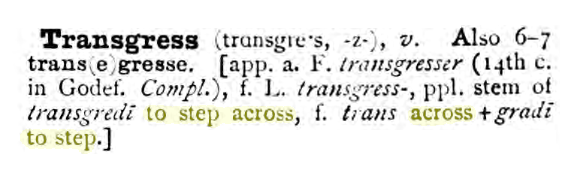
"It was added because of transgressions, ..."
|
| Source: Oxford English Dictionary |
Basically, God told the people at Mt. Sinai to come to the mountain and to stay so he could talk with them, but they decided they weren't having anything to do with God's way of talking to them, so they bolted from where he had told them to stay put. Thus, the law entered because the people "stepped beyond or across" from where God told them to be. They did not want to hear God and said "No. Not gonna happen." Entered in the Law, which had plenty of words for them to hear and to do.
Read about it in Deuteronomy 5
28 And the Lord heard the voice of your words, when ye spake unto me; and the Lord said unto me, I have heard the voice of the words of this people, which they have spoken unto thee: they have well said all that they have spoken.
(God basically said, "I heard them loud and clear. They don't want to talk with me.")
29 O that there were such an heart in them, that they would fear me, and keep all my commandments always, that it might be well with them, and with their children for ever!
(This is where God laments and wishes the people had talked with them so that "it might be well with them, and with their children for ever!")
After that, God told Moses to tell the people to go to their homes but for Moses to stay so he could give him the Law to give to them, but, remember, the giving of the Law was not God's first choice as he could have given that without Mt. Sinai in the first place.
No. What happened at Mt. Sinai was super special! Never, in the history of mankind, had God called an entire race together to talk with them in public - never - and they said, "No". They sent Moses instead. I am sure they did not expect for Moses to come back with the Law. I am sure that was a shock!
To give you an idea of that shock, when Ezra read the Law to the Israelites, after Nehemiah completed rebuilding the temple and the wall, they wept and mourned.
Here, read it below:
Nehemiah 8:9
And Nehemiah, which is the Tirshatha, and Ezra the priest the scribe, and the Levites that taught the people, said unto all the people, This day is holy unto the Lord your God; mourn not, nor weep. For all the people wept, when they heard the words of the law.
There is definitely a penalty for walking away from God's voice. 
I could go on about this some more, but my post here is just to get you to think about the fire that Moses honored but the children of Israel feared and ran away from, which running away from it brought the Law upon them. What a consequence, right?
It's come up in our family (one of the kids recently got dumped), whether if the one who dumped should be allowed to continued to be in contact with the one who got dumped. This is not from a parental position but from my kid's position - that viewpoint. So I was asked by my child, and I gave my answer, which was, "How do you feel? What do you want to do?" Later, on another day, Mom was asked and gave her response, which was the same as mine. I just so happened to be present.
Then she and I both chimed in with this, "It depends on how you were dumped. If you were dumped without a discussion, then the one who dumps gets a zero access level and shouldn't expect anything else. It comes with the territory of how the dump went."
I used to not feel that way. But I have experienced time and time again that the same behavior will keep happening (the nature of the dump) by letting the person have greater than zero access level clearance.
It's nearly impossible to go from having had been vulnerable without limits to getting cut deep and cut off and becoming guarded to later being asked to go away from the security of being guarded and dropping that guard to becoming AS vulnerable again as before.
The fear of being cut deep again is perhaps too much (probably for most people), which is where our child is presently. The distaste for that treatment has no pleasure in it that is worth a reunion.
When someone cuts you emotionally when you are trusting that person to not cut you, it's just not the same anymore - the euphoria - the trust - unless some miracle happened to change the person who did the cutting. I imagine it's similar to dropping a baby from a cuddle to a street corner and then expecting the child to trust that cuddle again.
So our child is that riveted with this being the first serious "like". Waiting until after college is our kid's thought now. That's how bad it hurt.
I get it. I do. Personally, for me to have liked someone and then to see that person move on, especially with someone else, is a deep cut. Then for that person to expect to think that eventually reconnecting will restore what was tossed, um, no. Realistically, fear is ever present now.
It's easier to have memories of what was better before and expected to have become sweeter in time ... easier to remember those memories and that momentum ... than to be burdened with having to calculate "what reality has become" + "what reality is likely to be" = "since having had since experienced rejection by that person".
For me, it is easier to remember the past for as good as I had believed it to be rather than to dream of a future knowing that that blade once swung so precisely to purposely cause that injury that it could swing just so easily again. It's as if a person pointed a gun at my head and then said, "What's wrong? I was just kidding."
I now know the best it could have been but not the worst of what is yet to come, so "Hard pass!" is easier of a reply to trust coming from me rather than trying to not trust the fear of being dumped again by that same person for whatever reason it was as before.
So I supported my child in the decision held because I get it, I got it, and I've experienced it. Sometimes, we as parents can stuff the past and move on, but when our children experience something similar to our experiences and then ask for advice on it, that is when our "senses" kick in.
Out of what is safe for our children, we instruct our children to protect their hearts even better than we might tend to instruct ourselves to protect our own hearts.
What is best is to realize sooner rather than later is that if that was love, no, it wasn't. Love doesn't do that kind of damage. It's over.